
Weekly Wrap Up – 12 December 2025
Stay informed on Australia’s latest political, policy and economic developments with GRACosway, Australia’s leading public affairs and strategic communications firm. Subscribe to our free publication here for insights on government relations, corporate and financial communications, and issues shaping business and policy.
Australia’s political week has been shaped by a nervous energy – partly driven by worsening fuel security concerns, and partly by cautious optimism around the long-awaited trade agreement breakthrough with Europe.
The fuel story is the more immediate pressure point. Escalating tensions involving Iran have sharpened fears regarding Australia’s already fragile supply chain. With fuel reserves low by international standards, fears of disruption are no longer abstract – warnings of tighter supply and price spikes are beginning to filter through to motorists and industry alike. Rising anxiety is now spilling into public debate, with warnings of tighter supply and price spikes filtering through to motorists and industry alike. The urgency of the situation has prompted the Prime Minister to convene a second emergency National Cabinet meeting next week, underscoring the need to respond to rising public anxiety with coordinated political action.
Against that uneasy backdrop, the announcement of the long-negotiated Australia–EU Free Trade Agreement (AEUFTA) landed as a welcome circuit breaker – at least politically. The trade deal, estimated to be worth $10 billion over time, promises cheaper electric vehicles, improved job mobility, and expanded market access, alongside headline concessions such as amendments to Australia’s luxury car tax, a win likely to please European manufacturers, particularly German exporters.
However, beneath the surface, the agreement for now is more promise than reality. Before any tangible benefits flow, it must navigate a complex ratification process on both sides of the agreement. This approval system is more complex on the European side of the agreement, where approval is required across the European system – through the European Council and Parliament – where impacted individual member states will likely vote down the deal. So, while the trade deal offers a strategic glimmer of diversification at a time of fuel insecurity, it remains, for now, largely symbolic until it is ratified by both sides.
Watch this space.
Top talking points
Parliament Sits: The Government introduced stricter laws and tougher penalties on illicit tobacco and vaping. Other legislative priorities also include increased transparency on private health fees, amendments to AML/CTF laws, and misconduct in the fuel sector.
Data Centres Framework: Tim Ayres and Andrew Charlton released a national interest framework for data centres and AI, establishing five expectations centred on national security, resilience, and social licence.
Smelter Bailout: The Federal and Queensland Governments will jointly provide $2 billion to support Rio Tinto’s Boyne smelter, securing the long-term future of Australia’s largest aluminium smelter in central Queensland.
Federal Polling: Polling shows One Nation has overtaken the Coalition as the largest opposition party, with projections of 46–55 seats, while Labor retains a strong lead with 77–86 seats.
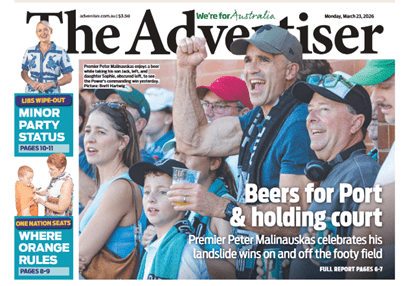
South Australian Election: South Australia’s Labor Party, led by Peter Malinauskas, won the election, securing at least 32 of the 47 House of Assembly seats. See our post-election note here.
Making headlines this week
Key Fuel Security Developments
Moves Australia-EU Free Trade Agreement in Detail
Negotiations for the AEUFTA began in 2018 but stalled in 2023 over disputes on agricultural access and the EU’s strict GI rules. Talks regained momentum amid shifting global trade dynamics, including US President Donald Trump’s “Liberation Day” tariffs. The agreement was signed on 24 March by Anthony Albanese and Ursula von der Leyen. While the AEUFTA undergoes a ratification process on both sides, the deal is expected to deliver gains for Australian agriculture, particularly improved market access for red meat exports to Europe. A key compromise involved GI carve-outs allowing continued use of names such as Prosecco, Feta, and Parmesan, despite EU sensitivities, while concessions on Australia’s luxury car tax, including tariff reductions, were central to finalising the deal.
Things to watch
30 March: The Federal Parliament will convene.
30 March: The AFR will host the Healthcare Summit 2026 in Sydney.
30 March: CEDA will host New South Wales Planning Minister Paul Scully to discuss environmental approvals.
31 March: The Victorian Parliament will sit.
31 March: The RBA will release the Conclusions Paper for the Review of Merchant Card Payment Costs and Surcharging.
1 April: Dr Martin Parkinson and Violet Roumeliotis will address the National Press Club, discussing productivity and skills.
1 April: The ABS will release Building Approvals data.
2 April: The ABS will release International Trade in Goods data.
Inflation, APRA, and Legislative Updates
Inflation reduced to 3.7 per cent across the year to February, down from 3.8 per cent in January. Trimmed mean inflation was unchanged at 3.3 per cent.
APRA commenced consultation on implementing the Retirement Reporting Framework. The Framework aims to improve oversight of the retirement phase of superannuation by enabling more consistent monitoring of member outcomes in retirement.
Michelle Rowland introduced legislation to prevent convicted child sexual abusers from shielding assets in superannuation. At the same time, Daniel Mulino passed legislation allowing employers greater flexibility to request stapled super fund details during onboarding.
Ministerial and Overseas Visits
Penny Wong welcomed President of the Federated States of Micronesia (FSM) H.E. Wesley W. Simina to Canberra, announcing plans to formalise joint maritime security cooperation through a new bilateral agreement.
Matt Thistlethwaite represented Australia at the 14th World Trade Organization (WTO) Ministerial Conference in Cameroon. Australia supported a permanent moratorium on customs duties for electronic transmissions and supported the creation of the WTO’s first standing committee on digital trade.
Federal Minister of Defence of Germany, Boris Pistorius, visited Canberra to strengthen cooperation between defence forces. Pat Conroy hosted Minister Pistorius in Brisbane to discuss joint capability development between Australia and Germany.
Energy Security Statement, Gas Supply, and Agriculture Supply Chain Developments
Anthony Albanese and Lawrence Wong released a joint statement reaffirming Australia and Singapore’s commitment to energy security, including maintaining the flow of diesel and LNG between the two countries amid growing instability in the Middle East.
Chris Bowen communicated that Australia’s gas supply outlook has improved, with shortfall risks delayed by a year. However, gaps remain until 2030, requiring new supply investment despite declining demand due to electrification.
Julie Collins commissioned a National Food Supply Chain Assessment to strengthen resilience amid Middle East conflict impacts. It will first examine diesel supply, then other key inputs, and provide steps to protect food production and supply chains.
Social Media, Housing Approvals, and Fair Work Amendment Updates
Anika Wells announced updated social media minimum age rules, which now clarify that “age-restricted social media platforms” include services with addictive features such as recommender algorithms, endless feeds, feedback features, and time-limited features such as stories.
Clare O’Neil reported that the National Housing Supply and Affordability Council’s first Quarterly Outlook showed building approvals and commencements have risen by 17 per cent since the Accord began, reflecting strong growth across the housing sector.
Amanda Rishworth and Catherine King introduced the Fair Work Amendment (Fairer Fuel) Bill 2026, which, if passed, will give the Minister power to make emergency changes to contract chain orders in road transport and enable the Fair Work Commission to consult and implement actions quickly.
Minimum Wage, Food Standards Appointment and Industrial Action Moves
Amanda Rishworth recommended an increase to the minimum wage award, through a submission lodged to the Annual Wage Review, communicating that the increase would help ease pressure for low income workers.
Rebecca White announced the appointment of Robyn Kruk as Acting Chair of the Food Standards Australia New Zealand Board, replacing Glenys Beauchamp AO PSM.
Victorian teachers rallied in protests following the Australian Education Union’s (AEU) rejection of the state government’s 17 per cent pay increase offer. The strikes caused public school closures, prompting Jacinta Allan to urge unions to avoid further industrial action to prevent disruption for families.
In case you missed it...
