Bridging the housing gap
2026-27 FEDERAL BUDGET OVERVIEW
A Budget aimed at making home ownership more attainable for younger Australians, easing cost-of-living pressures, whilst reining in spending, was unveiled tonight by Treasurer Jim Chalmers, the Albanese Government’s first budget since its emphatic 2025 re-election.
Against a backdrop of global energy shocks, climbing cost-of-living and increasing national debt, the Treasurer announced sweeping housing and tax reforms, in particular the biggest changes to negative gearing and capital gains tax in a quarter of a century. Despite repeatedly denying Labor would change negative gearing rules during and after the 2025 election campaign, the government has changed its approach, believing such reforms are necessary to rebalance the taxation of investments such as housing away from asset rich Australians (investors) and towards income earners (first home buyers), in an attempt to mitigate any exposure to accusations of “broken promises”.
On budget repair, the government intends to cut almost $38 billion over the forward estimates out of the NDIS, and to scrap the additional private health insurance subsidy for people over 65, netting approximately $3 billion in the same period.
At a time of domestic and global political uncertainty, the government’s Budget themes of housing, inflation, productivity and innovation are clearly aimed at a generation of Australians who are struggling under cost-of-living pressures and unable to see a way forward to home ownership and economic security.
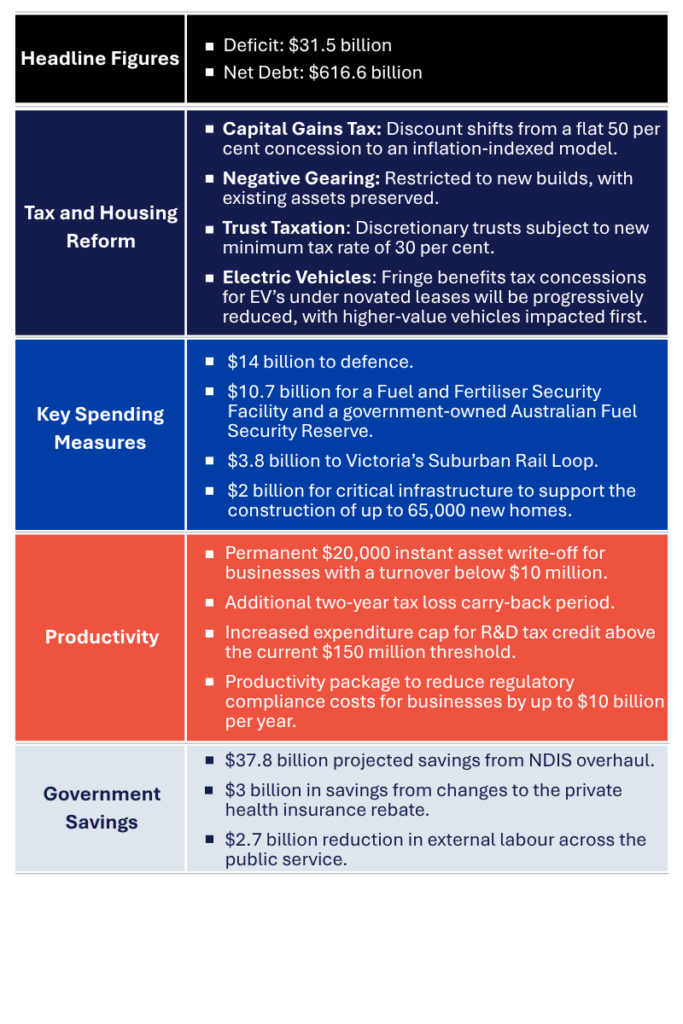
Core announcements and headline figures delivered in the 2026-27 Budget include:

Tax and housing reform
The Budget reduces the capital gains tax (CGT) discount by replacing the current blanket 50 per cent discount with an indexation-based approach. Under the new regime, capital gains will be discounted in line with inflation over the period an asset is held, and will apply to all CGT assets, including those held pre-1985. Meanwhile, property investors will only be able to claim negative gearing on new builds, as part of the government’s changes. Both will apply from 1 July 2027, subject to relevant exemptions. The final change, as part of the government’s tax trio is a minimum tax on all distributions from trusts of 30 per cent, aligning their treatment more closely with company tax.
The Budget also begins to phase down the fringe benefit tax for electric vehicles purchased through novated leases. From April next year, electric vehicles with a value above $75,000 will become partially subject to fringe benefits tax, with the concession further wound back from 2029 to apply.
New spending measures
As previously flagged, major spending is concentrated on defence and fuel security, a likely reaction to the current geopolitical environment. Defence spending received an injection of $14 billion over the next four years, and a further $10.7 billion has been committed to establish a Fuel and Fertiliser Security Facility and a government‑owned Australian Fuel Security Reserve.
Beyond national security, Victoria’s Suburban Rail Loop was allocated $3.8 billion and separately, $2 billion will go toward enabling infrastructure to support the construction of up to 65,000 new homes.
Approximately 6.2 million Australians will be able to claim a $1,000 instant tax deduction without receipts from the 2026–27 financial year, and separately receive a one‑off $250 tax cut from the 2027-28 tax year. These changes are cost neutral as they are offset by announced savings and revenue measures.
Productivity
The Budget includes a suite of measures aimed at lifting productivity. The $20,000 instant asset write‑off will be made permanent for businesses with turnover below $10 million, allowing the immediate deduction of eligible asset purchases. Small businesses will also gain access to an additional two‑year tax loss carry‑back period, enabling current losses to be offset against taxable profits from the previous two years.
To support innovation and improve Australia’s competitiveness as an investment destination, the Government will increase the expenditure cap for the Research and Development tax incentive above the current $150 million threshold. Separately, the Budget includes a productivity package designed to reduce regulatory compliance costs for businesses by up to $10.2 billion per year.
Government savings
The Budget includes significant savings measures, led by reforms to the National Disability Insurance Scheme (NDIS). The Government projects a reduced growth in NDIS payments by $37.8 billion over four years from 2026–27, through changes aimed at moderating the growth of the scheme.
The government will also achieve around $3 billion in savings from changes to the private health insurance rebate. The higher rebate tiers for Australians aged over 65 will be removed, instead receiving the standard 24 per cent rebate, subject to income thresholds. Additional savings include $2.7 billion from reduced use of external labour across the public service.
For further information on key portfolio measures, please refer to GRACosway’s detailed briefings:
 Defence | Foreign Affairs and Trade
 Home Affairs | Attorney-General
 Health and Aged Care | Social Services
 Housing, Homelessness and Cities
 Infrastructure, Transport, Regional Development, Communications, Sports and the Arts
 Employment and Workplace Relations | Education
 Industry, Science and Resources
 Climate Change, Energy, the Environment and Water | Agriculture, Fisheries and Forestry
Further reading
For more details on the 2026–27 Federal Budget, explore the official materials below: