Weekly Wrap Up – 12 December 2025
Stay informed on Australia’s latest political, policy and economic developments with GRACosway, Australia’s leading public affairs and strategic communications firm. Subscribe to our free publication here for insights on government relations, corporate and financial communications, and issues shaping business and policy.
With Parliament on its mid-winter recess, the focus shifted to geopolitics this week. The perilous nature of Australia and the Indo-Pacific region’s strategic circumstances was highlighted in one of the starkest terms in recent memory, as China tested a submarine-launched nuclear-capable ballistic missile into the Pacific on Monday. There has been much commentary over the symbolism and dissection of China’s intent throughout the week. Was it a signal to Pacific countries and Australia, a warning shot against increased security ties? Perhaps.
More importantly, though, it represents a public step forward in China’s nuclear weapons capabilities toward a survivable sea-based deterrent. The US and Australian governments have been warning us about China’s nuclear modernisation and buildup of its arsenal, which they say has been done without transparency. Experts say this latest test indicates China has successfully developed its ability to strike targets such as Australia, putting us firmly in the window for nuclear blackmail and coercion.
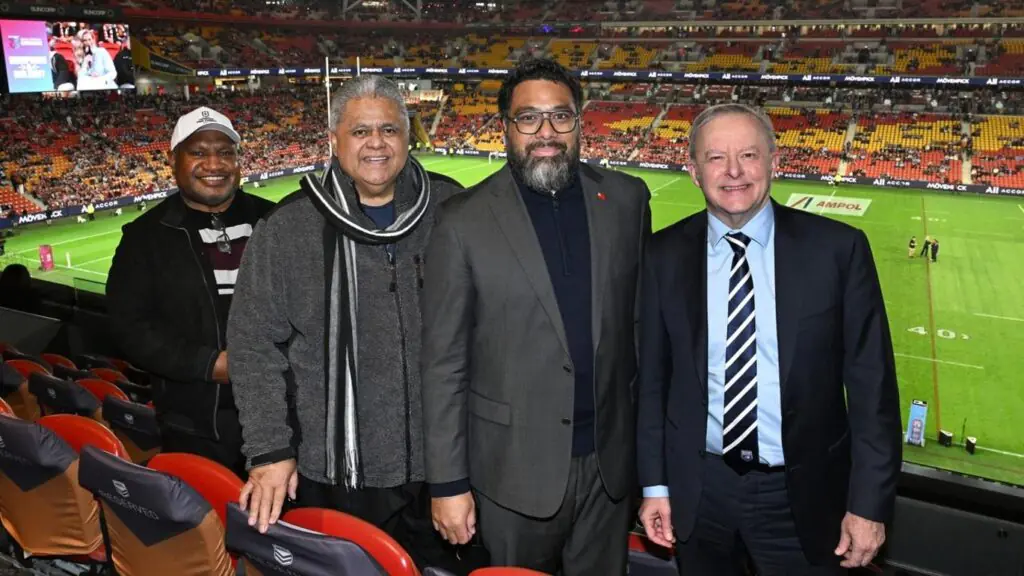
No doubt the timing of China’s test was curious, coinciding with a diplomatic blitz in the Pacific by the Prime Minister focused on security. As former Home Affairs Secretary Mike Pezzullo noted, that would have required intelligence on the Prime Minister’s schedule. It began in Fiji, where he signed landmark security and economic agreements with Prime Minister Sitiveni Rabuka. In the Solomon Islands, the Prime Minister sought to deepen ties with Prime Minister Matthew Wale, with negotiations continuing on a new bilateral security treaty. Returning home, the Prime Minister hosted the Prime Ministers of Papua New Guinea, Tonga and Samoa in Brisbane, combining bilateral meetings with an appearance at the State of Origin decider.
The Prime Minister capped off the week by shoring up an important partner in hedging against China, hosting Indian Prime Minister Narendra Modi in Australia. Modi received the usual rockstar welcome from members of the diaspora at Marvel Stadium. The meeting resulted in closer defence cooperation and an agreement on uranium exports for peaceful nuclear purposes, a symbolic counterpoint to China’s earlier nuclear provocations.
One thing is certain, we will be hearing a lot more about the geopolitical fallout from this week over the weeks to come.
Stay tuned.

Top talking points
Prime Ministerial Travel: Anthony Albanese visited Fiji and Solomon Islands, where he signed the Vuvale Union and Ocean of Peace Alliance agreements, before attending the Solomon Islands’ Independence Day celebrations.
Prime Ministerial Meetings: Anthony Albanese continued regional discussions with Papua New Guinea’s Prime Minister James Marape, Tonga’s Prime Minister Fatafehi Fakafānu, and Samoa’s Prime Minister Laʻauli Leuatea Schmidt ahead of the State of Origin decider in Brisbane.
Prime Minister Narendra Modi: Anthony Albanese met with Prime Minister of India Narendra Modi for the Australia–India Annual Leaders’ Summit in Melbourne.
Royal Commission on Antisemitism and Social Cohesion: The Royal Commission heard evidence from social media companies, including Meta, TikTok, Facebook, and Kick.
China ICBM: Anthony Albanese condemned China’s launch of an intercontinental ballistic missile into the South Pacific.
Making headlines this week
Australia’s Approach to AI
Telstra Network Outage
A nationwide Telstra outage on Wednesday disrupted mobile calls, data services, EFTPOS terminals, train networks and some Triple Zero calls, affecting thousands of Australians. Telstra said the outage was caused by a software fault involving network time-synchronisation systems and was not a cyberattack, restoring most services within hours. While the core Triple Zero system remained operational, some callers could not connect, triggering hundreds of welfare checks. The outage also disrupted Victoria’s V/Line regional train network. Anika Wells declared that ACMA would investigate the outage and whether Telstra met its legal obligations, as questions were raised about the company’s correspondence with government. The disruption followed Optus’ Triple Zero service outage in September 2025, which prompted sweeping reforms to emergency communications and Vodafone’s mobile coverage outage in June 2026.
Things to watch
ASIC, APRA, and Treasury Updates
ASIC will conduct a surveillance review into Australia’s Big Four accounting firms, examining how they handle internal complaints, including whistleblower reports and the alleged misuse and disclosure of confidential information.
APRA finalised reforms to the general insurance and reinsurance framework, introducing targeted changes to improve access to alternative reinsurance arrangements and strengthen capital oversight. The reforms will take effect on 1 January 2027.
Treasury opened consultation on the Government’s proposed 30 per cent minimum tax for certain discretionary trusts, seeking feedback on rollover relief, the treatment of excess franking credits and tax collection mechanisms.
NATO, Diplomatic Appointments, and Defence Procurement Moves
Pat Conroy travelled to Türkiye to represent Australia at the 77th NATO Leaders’ Summit. Discussions focused on strengthening Australia’s partnership with NATO and addressing shared security challenges across the Indo-Pacific and Euro-Atlantic regions.
Penny Wong announced eight senior diplomatic appointments, naming ambassadors to Croatia, Kuwait, Mexico, Thailand and APEC, as well as High Commissioners to Ghana and Nauru, and a Consul-General to Indonesia.
The Federal Government awarded a contract to Electro Optic Systems Defence Systems to develop the R400 SLINGER Counter-Uncrewed Aerial Systems capability. This integrated remote weapon system is designed to detect and defeat small and medium-sized drones.
Uranium, ARENA, and Critical Minerals Developments
Anthony Albanese and Narendra Modi announced a landmark uranium export agreement, enabling Australian uranium shipments to India while deepening cooperation on clean energy, critical minerals, and supply chains.
Chris Bowen announced the appointment of Simon Corbell as ARENA Chair, alongside Miranda Collard, Mary O’Kane and Grant King as new board members.
In an address to the ANU National Security College, Madeleine King highlighted the strategic importance of critical minerals. King discussed the importance of international partnerships, diversified supply chains and stronger sovereign industrial capability.
Metro, Online Safety, and Housing Moves
Catherine King announced the arrival of the first of 12 trains for the Sydney Metro – Western Sydney Airport Line, with the remaining 11 trains scheduled to be delivered over the coming months.
Submissions opened for the inquiry into the Online Safety Amendment (Strengthening Enforcement for the Social Media Minimum Age) Bill 2026, with a public hearing scheduled for 4 August.
The Housing Delivery Authority’s latest round declared additional proposals of state significance, adding 22,000 potential homes to the fast-tracked planning pathway, in efforts to accelerate housing supply across New South Wales.
NDIS, International Students, and AI Employment Report Updates
Mark Butler announced that a new Technical Advisory Group convened for the first time. The group will provide advice on the development of the NDIS eligibility assessment framework. Co-chaired by Professor Christine Imms and Mary Wood, the group will provide advice throughout 2026–27.
Jason Clare confirmed there will be no increase to the National Planning Level (NPL) for international student commencements in 2027. The NPL cap will be maintained at 295,000, 8 per cent below the immediate post-pandemic peak.
The Department of Employment and Workplace Relations released its inaugural AI and Employment in Australia report, finding the labour market has remained resilient despite the growth of generative AI. Employment continues to grow across both highly AI-exposed and less AI-exposed occupations.
In case you missed it...
State of Diplomacy